Coherent movers change course when their path is interrupted
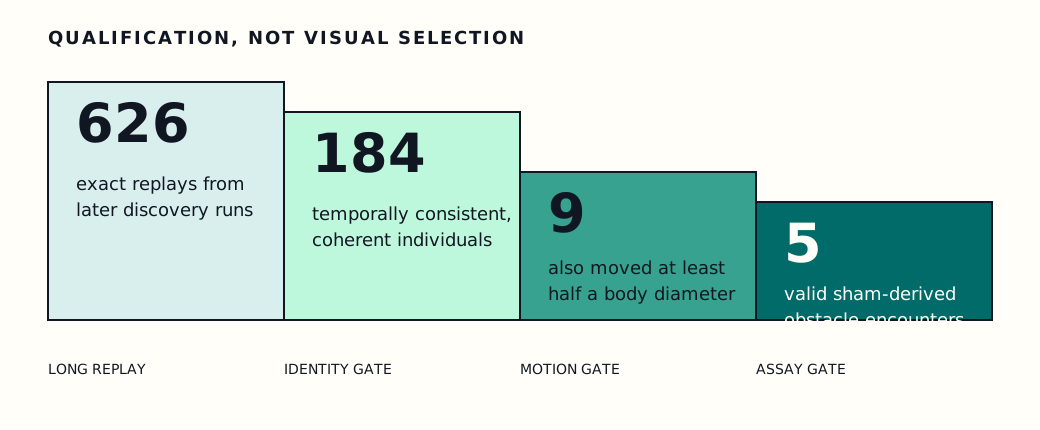
We replayed 626 specimens from later locomotion and persistence campaigns, found nine that remained coherent while moving at least half a body length, and placed an unseen obstacle on each specimen’s future sham path. Five produced valid paired encounters. Across their fifteen obstacle trials, median progress fell to 18% of the matched sham and median heading changed by 26°. The responses were strong, but they were not simple avoidance.
The obstacle caused deflection, arrest, and one near-reversal
Every valid obstacle branch made contact and every organism departed from its unobstructed trajectory. No trial lost matter: retained mass remained at 100% within numerical drift. What changed was the organization and direction of that matter. Two specimens continued at roughly 30% of sham speed with modest turns; two almost stopped while turning about 60°; one response included an approximately 180° reversal and a marked loss of dominant-body coherence.
This establishes causal sensitivity to the obstacle. It does not establish sensing, planning, or cognition. The obstacle directly changes the local flow field, so some response is mechanical. The scientific question is whether morphology and rule state predict the form and recovery of that response.
The later compendium did contain coherent movers
The archive contains sixteen later campaigns built around individual persistence, locomotion, compact bodies, and shape preservation. Their 626 exact exports were replayed for 3,600 steps with all state channels included in the body measurement.
Of those replays, 184 passed the temporal-individuality threshold and nine also moved at least half a body diameter. They came from four discovery campaigns and moved between 0.59 and 2.09 body diameters. These are not visually selected “organic-looking” patterns. Each passed a quantitative identity test before its motion was considered.
“Organic” means temporally consistent and coherent
A specimen counts as an individual when the same localized body persists through time. The score is the weakest of five measurements, so strength on one axis cannot conceal failure on another. Movement is applied only after this identity gate.
The grid grew; the creatures did not
Several bodies occupied too much of their native 128² or 256² arena to place an obstacle entirely outside them and still leave enough runway for contact. We therefore recentered each exact state patch in a 512² wall arena. The rule parameters, two state channels, 5×5 connectivity between each channel pair, time step, reintegration, and patch contents remained unchanged.
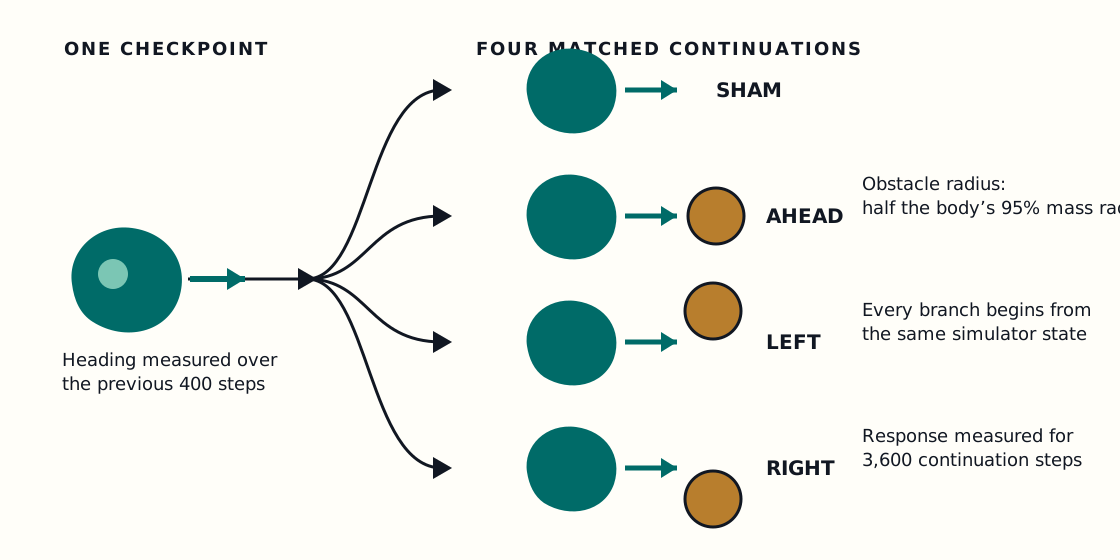
Each specimen developed for 1,200 steps. Its recent displacement defined a heading. A 3,600-step sham continuation then supplied the earliest future position where ahead, left, and right placements would all begin clear and later intersect the body. The three exposed branches began from the identical checkpoint. The obstacle was an external circular wall potential with radius half the body’s 95% mass radius; it did not erase state or add a sensor channel.
Swipe or scroll to inspect the labels
The strongest individuals bent; the weaker ones stalled
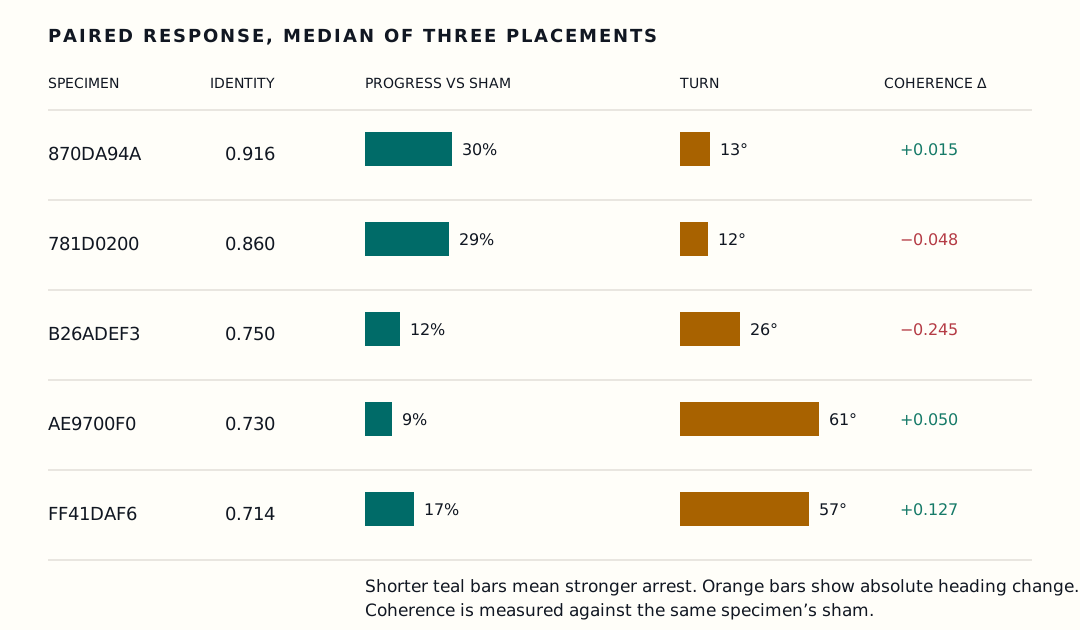
The two highest-scoring individuals, 870DA94A and 781D0200, kept about 30% of their sham progress and changed heading by 12–13°. Three specimens nearer the identity threshold made only 9–17% of sham progress and showed larger median turns. B26ADEF3 was different again: one branch nearly reversed while its dominant-body coherence fell sharply.
With only five organisms, this ordering is a hypothesis rather than a fitted relationship. Still, it suggests that temporal individuality may also measure mechanical robustness: more internally stable bodies absorb a local perturbation without as much reorientation or arrest. A larger cohort should test that directly while holding lineage apart.
Swipe or scroll to compare every response measure
| Specimen | Identity | Prior motion | Progress / sham | Turn | Coherence Δ | Reading |
|---|---|---|---|---|---|---|
| 870DA94A | 0.916 | 1.40 bodies | 30% | 13° | +0.015 | deflects, then continues |
| 781D0200 | 0.860 | 1.58 bodies | 29% | 12° | −0.048 | deflects with mild disruption |
| B26ADEF3 | 0.750 | 1.68 bodies | 12% | 26° | −0.245 | branch-dependent breakup; one reversal |
| AE9700F0 | 0.730 | 2.09 bodies | 9% | 61° | +0.050 | strong turn and arrest |
| FF41DAF6 | 0.714 | 1.90 bodies | 17% | 57° | +0.127 | strong turn and arrest |
A response map should predict a vector, not a “swerver” label
The original question divided organisms into those that turn away and those that die on contact. Neither category fits these trials. Matter was conserved in every exposure, while course, speed, scale, and connected-body coherence changed independently. Those are separate response variables and should remain separate in the map.
The signed lateral result is especially revealing. Among ten side-placement trials, four bodies moved away from the obstacle side and six moved toward it. A uniformly repelled point mass would not produce that mixture. Body shape, internal flow, and handedness are interacting with the perturbation. Repeating mirrored initial conditions would tell us whether this asymmetry belongs to morphology or to an intrinsic chiral mode.
Five assayed organisms are not enough to ask whether one response occupies a connected region of the old map, especially because they come from two related rule families. They are enough to replace the old endpoint. The next map should predict forward progress, signed lateral displacement, turn, coherence loss, and recovery time, with rule lineage held out during validation. A connected response region may then emerge without forcing qualitatively different interactions into one binary label.
Not every coherent mover can be assayed by this geometry
Two specimens never reached a position where all three obstacles could begin clear and later intersect the sham body. One did not move far enough during the heading window. One developed a diffuse 99% matter radius above the arena limit even on the 512² grid. These are protocol exclusions, not nonresponses, and they remain in the cohort receipt.
The diffuse specimen also exposes a measurement issue worth pursuing. A stable compact core can carry a low-density halo that dominates a 99% mass radius. The identity model should represent core and halo separately, rather than asking one radius to serve as both organism boundary and long-range material field.
Updated 2 September 2026. The qualification screen used 626 exact replay bundles from sixteen later Flow Lenia campaigns. The assay used a 512² wall arena, two state channels, the specimens’ original 5×5 channel connectivity, a 1,200-step checkpoint, and a 3,600-step paired continuation. Claims above are descriptive for five organisms and fifteen exposed branches; no predictive model was fitted.