What does shape fail to tell us?
We placed 25,167 Flow Lenia specimens, 859 EmbryoMaker snapshots, and 232 fish outlines in one map built from the same twelve measurements. Unlike the biological datasets, Lenia also gives us the rule that produced each body. We can therefore ask where shape is an adequate description, where different rules land near the same measured form, and whether that missing information changes how a body responds to an obstacle.
Shape is informative, but it is not a complete state
All three datasets contain persistent gaps surrounded by observed forms. In Lenia, those gaps let us trace closed paths through nearby bodies and compare the rule states at the beginning and end. A small minority of paths return to the same measured neighborhood without cleanly returning to the same rule state. Five independently selected coherent movers also respond differently to matched obstacle encounters. This gives us a precise next test: measure how well morphology predicts response, then ask whether the attached rule state explains the remaining differences.
One coordinate system, three kinds of body
Every specimen is reduced to the same twelve normalized measurements of form and motion. Distances therefore mean the same thing across the three datasets. But the reduction discards information. If two bodies differ only in an unmeasured rule variable, the map places them together.
The map records form and leaves the rule attached
Each Flow Lenia specimen begins with a known rule set. We run the rule, measure the resulting body, and place it in the twelve-dimensional map. Different rules can land close together because the coordinates describe the result, not every parameter that produced it. Since Lenia preserves that provenance, we can compare nearby bodies both as forms and as products of particular rules.
Fish and embryo datasets provide forms without a complete generative state. Lenia provides both. This makes the synthetic system useful for measuring what a morphology-only comparison necessarily omits.
Swipe or scroll to inspect the labels
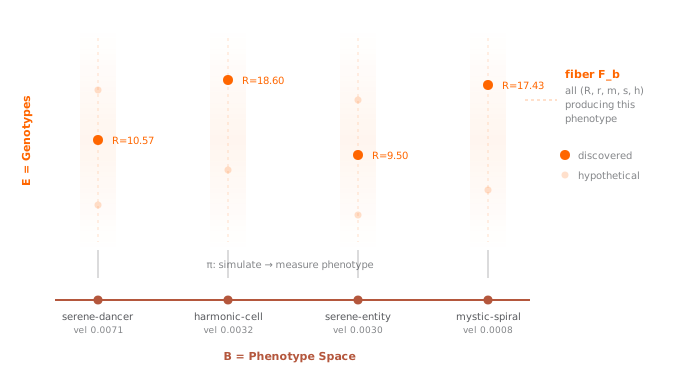
All three datasets leave structured gaps in form space
Here a loop means that observed forms surround a region the dataset does not occupy. As we widen the distance that counts as “nearby,” small gaps close quickly and larger ones persist. The strongest loop in the broad Lenia sample persists across 2.78 normalized distance units in a 4,096-landmark approximation. In exact dense runs, the single-family Lenia control reaches 0.80, fish reaches 0.64, and EmbryoMaker reaches 0.29. The number of detected loops depends on sample size, but the same calculation finds durable gaps in all three datasets.
In Lenia, a loop is also an experimental route. We can move through nearby forms around the gap, return to the starting neighborhood by a different path, and ask whether the generating rule returned as well.
Swipe or scroll to inspect the labels

A region selected without fish data is unusually fish-near
We selected a patch of 256 Lenia specimens using only the synthetic cloud’s loop geometry. We then compared it with the external datasets. Its median distance to fish is 3.30 rather than 5.90 for the broad Lenia sample, while its median distance to EmbryoMaker rises from 4.46 to 11.98. All 256 specimens reverse the broad sample’s fish-versus-EmbryoMaker ordering. Random patches produce a shift this large about once in a thousand permutations.
No fish measurement was used to find the patch. Its fish proximity was measured only after selection, so the result did not come from searching the Lenia archive for fish-shaped specimens.
Some closed paths in shape remain open in rule space
We found 4,802 groups in which nearby Lenia specimens trace a closed path through the measured map. In 109 groups, the ending rule state differs from the start more than in matched out-and-back controls at all three tested scales and under both closure measures. The joint count is only marginal under permutation (p ≈ 0.094), although the state-only and ratio-only tails are stronger (p ≈ 0.008 and p ≈ 0.0002). Dense reruns leave one joint survivor among five broad-corpus candidates and none among five candidates from the fish-near patch.
The cohort contains more rule-state residue than its controls, but the strict joint test is weak and dense validation removes most candidates. The result supports a narrow claim: morphology can hide rule-state differences in this corpus. It does not establish a general transport law or a dependable witness inside the fish-near patch.
The obstacle assay establishes that coherent bodies have measurable, multidimensional responses. It does not yet connect those responses to transport residue. The next test is whether shape-near bodies respond differently because their attached rule states differ.
Swipe or scroll to inspect the labels

Five coherent movers meet matched obstacles differently
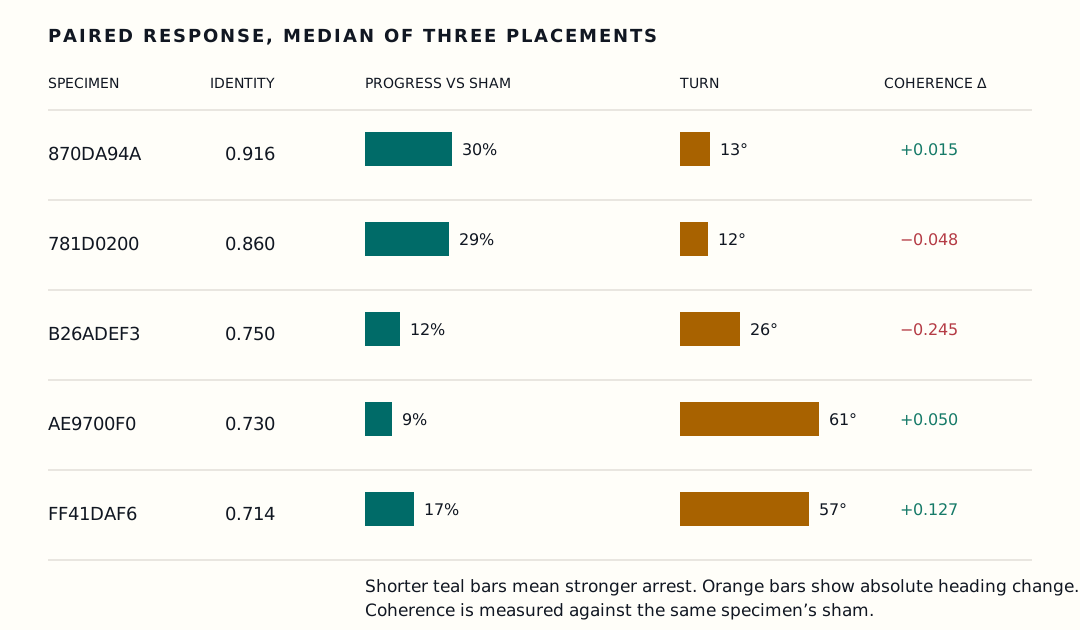
We searched later persistence and locomotion campaigns rather than choosing specimens by appearance. Of 626 exact long replays, 184 remained coherent through time and nine also moved at least half a body diameter. Five qualified for a paired assay. For each trial, the obstacle was placed from the unperturbed trajectory so that the body would encounter it. All fifteen exposed branches made contact, producing modest deflections, near-arrests, large turns, one near-reversal, and different changes in connected-body coherence.
Across the fifteen contacts, median forward progress was 18% of the matched sham and the median heading difference was 26°. Yet every branch conserved its total matter within numerical drift. Contact usually changed motion or organization rather than simply destroying the body, which is why “swerve or die” is too crude an outcome measure.
The map captures resemblance; the rule may explain divergence
The same calculation finds persistent gaps among synthetic bodies, a developmental model, and fish outlines. It also identifies a Lenia region that is fish-near despite being selected without fish data. Within Lenia, however, nearby measured forms can still carry different rule states. The map is useful both for the similarities it captures and for making its own information loss measurable.
The obstacle result sharpens the behavioral question. Progress, turning, lateral displacement, and coherence do not move together, even when matter is conserved. In the ten side-placement trials, four bodies moved away from the obstacle side and six moved toward it. There is no evidence here for a generic avoidance reflex. The response more plausibly depends on how body shape, internal flow, handedness, and obstacle placement interact.
One tentative pattern is worth pursuing. The two bodies with the highest temporal-individuality scores retained about 30% of sham progress and turned only 12–13°. Three bodies nearer the inclusion threshold retained 9–17% and turned more sharply. If this pattern survives a larger, lineage-held-out assay, temporal coherence may be measuring mechanical robustness as well as persistence. If it does not, the rule state may explain the difference that morphology and the current individuality score miss.
This page synthesizes the May 2026 morphology and transport analyses with the coherent-organism obstacle assay completed on 2 September 2026. The new assay contributes five organisms and fifteen exposed branches; its claims are descriptive, and no morphology-response predictor has yet been fitted.